

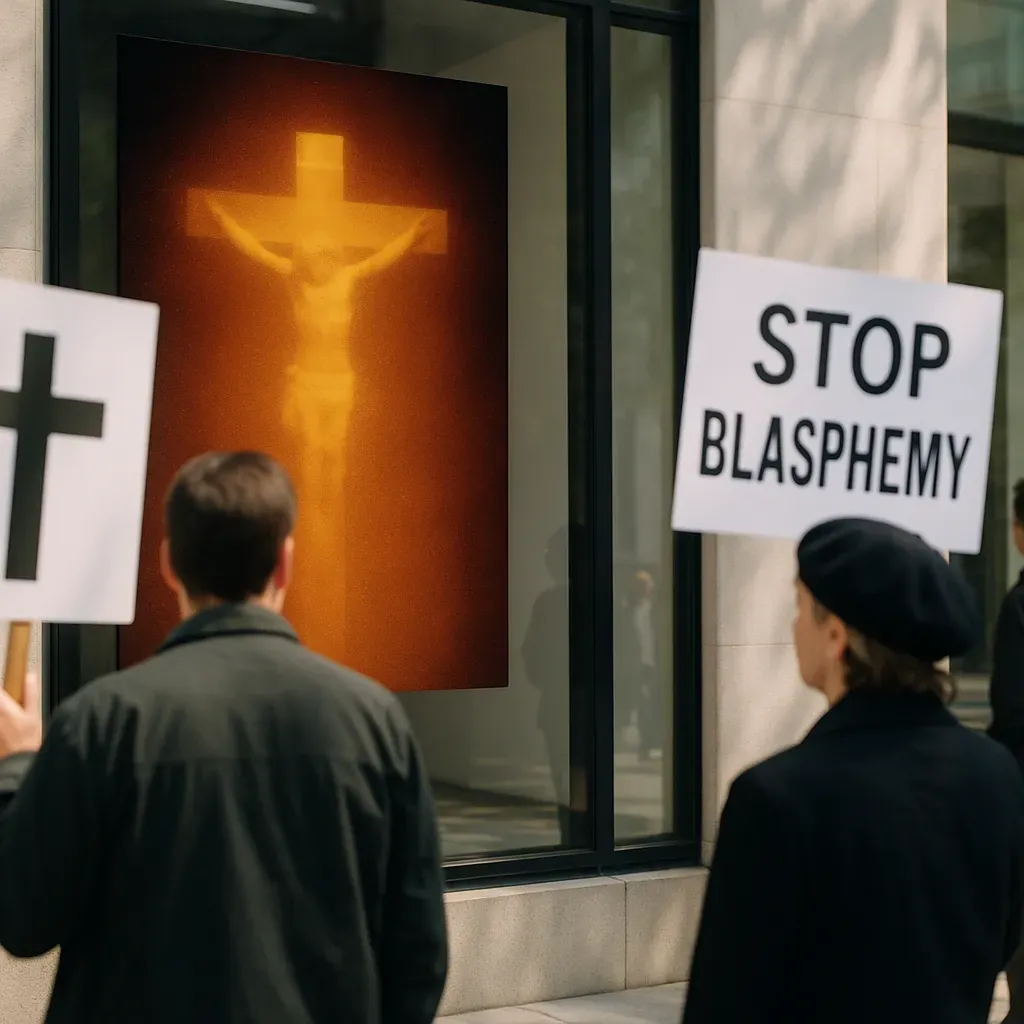
Religious iconography has been a defining element in the works of controversial artist Andres Serrano from the outset. Serrano, known for his eclectic collection of religious artifacts, intriguingly repurposes church pews as unconventional living room couches. Although he identifies as a nonobservant Catholic, his stance reflects an anticlerical attitude rather than being anti-Christian. Serrano communicates through art, embracing the aesthetic potential of religious symbols without making a direct statement for or against them. Just as Monet expressed beauty in haystacks, Serrano navigates the realm of religious imagery to explore its artistic dimensions.
In 1985, amid the thriving contemporary art scene, Serrano caught the attention of curator William Olander at the New Museum of Contemporary Art. Olander conceptualized a group exhibition titled “FAKE: A Meditation on Authenticity,” a project that delved into postmodern concerns about originality in art. The catalogue reminded viewers of the complexities surrounding authenticity in a high-tech world where reproductions often surpass the original in quality. However, Serrano was not driven by postmodernist ideals; his art emerged from a desire for striking images and innovative materials.
Inspired by Olander's project, Serrano introduced the concept of "fake paintings"—photographs that mimic the appearance of paintings while referencing illustrious works. One of his earliest creations from 1986, titled “Milk, Blood,” depicted dual Plexiglas containers holding animal blood and milk, respectively. This piece invited viewers to reconsider bodily fluids as artful mediums, drawing parallels to abstract expressions reminiscent of Piet Mondrian. Following this, he crafted monochrome works like “Piss,” utilizing urine to evoke Yves Klein’s iconic blue paintings, and “Blut und Boden (Blood and Soil),” nodding to Anselm Kiefer’s themes. Eventually, Serrano reintroduced representation into his works, culminating in the provocative piece “Piss Christ,” created in 1987.
In choosing the crucifix, Serrano embraced a symbol laden with ambiguous significance, a choice that fueled interpretations and discussions surrounding his work. Initially employing his wife’s urine, he later switched to his own, favoring its color. He constructed a two-gallon Plexiglas container to showcase the crucifix, measuring thirteen inches and ultimately presenting the photograph in a grand scale of sixty by forty inches, resembling an altarpiece.
The image, free of its title, might elicit no objection—its translucent, reddish-gold hues resemble effervescent, tear-like qualities. Esteemed critic Wendy Steiner recognized Serrano’s work as “some of the holiest images in contemporary art,” asserting its potential to connect deeply with viewers. Although “Piss Christ” does not claim to be the pinnacle of artistic sophistication, it embodies Serrano’s intent as an artist driven by artistic motivations.
Initially displayed at Stux Gallery in 1987, the photograph went unnoticed and sold poorly. However, in 1988, Serrano's trajectory shifted dramatically when the New Museum director nominated him for a fellowship awarded by the Southeastern Center for Contemporary Art (secca) in Winston-Salem, North Carolina. Serrano emerged as one of ten winners and received a grant of fifteen thousand dollars, setting in motion a series of events that catalyzed America's culture wars.
The term "culture war" finds its origins in the German concept of Kulturkampf, used during Bismarck's era to describe conflicts between the Catholic Church and the Prussian state. Its reintroduction into American discourse primarily stems from sociologist James Davison Hunter's 1991 book “Culture Wars: The Struggle to Define America,” which scrutinized the cultural cleavage ignited in the wake of the 1960s social movements. Subsequent historians have continued to delve into the complexities of these cultural conflicts, including Daniel T. Rodgers' “Age of Fracture,” which examines the fracturing of societal norms and values, and Andrew Hartman’s “A War for the Soul of America,” exploring the backlash against the progressive changes of earlier decades.
As Serrano’s journey unfolds—from the quiet gallery receptions to the explosive debates surrounding his work—his ability to evoke emotion and challenge perceptions remains pivotal. The lasting impact of his creations continues to resonate within contemporary art, ensuring the conversation surrounding identity, faith, and artistic expression remains vibrant and ongoing.
Gracias por leer Columna Digital, puedes seguirnos en Facebook, Twitter, Instagram o visitar nuestra página oficial. No olvides comentar sobre este articulo directamente en la parte inferior de esta página, tu comentario es muy importante para nuestra área de redacción y nuestros lectores.
Datos basados en información reportada originalmente por newyorker.com.
Reportar un problema en esta notaPolítica de correcciones

Deja un comentario