
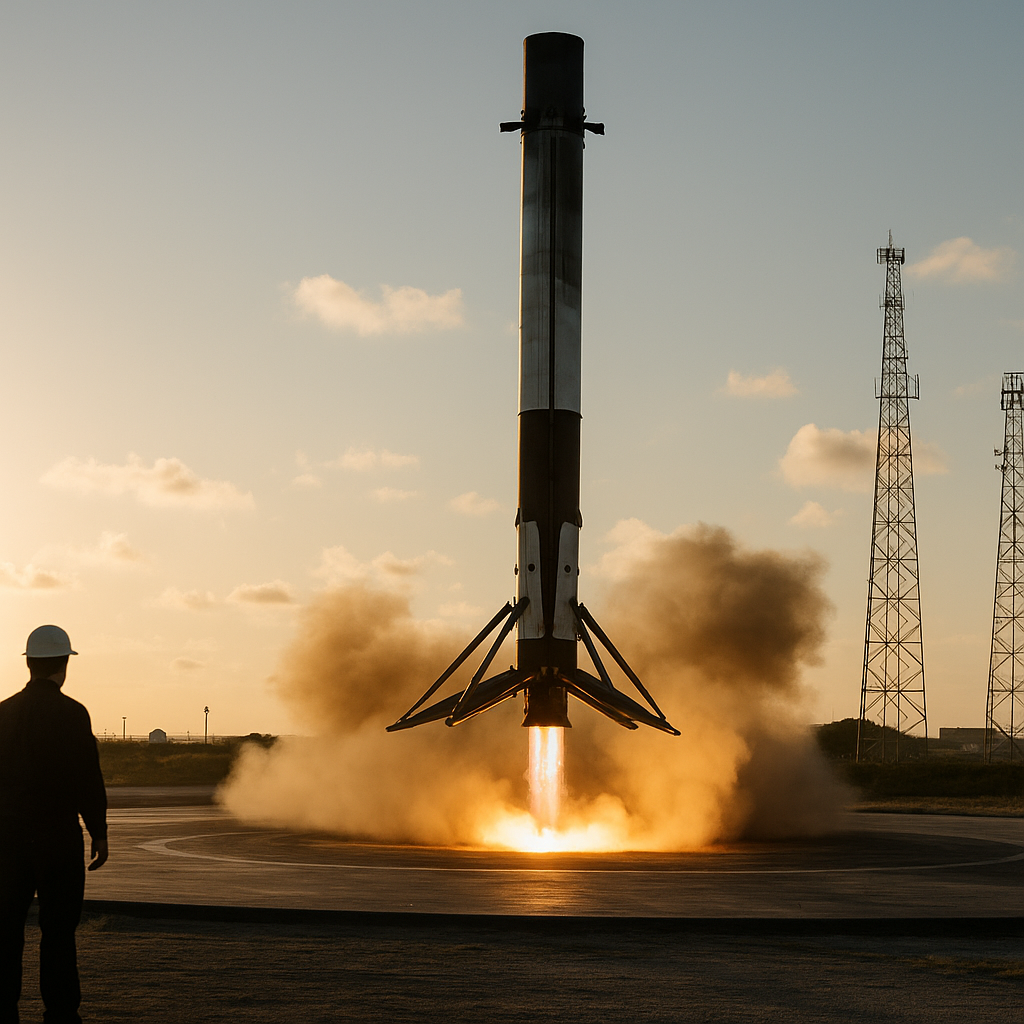
As SpaceX’s Starship vehicle garnered widespread attention recently, the company’s reliable workhorse, the Falcon 9 rocket, silently achieved remarkable milestones. Both events occurred during routine launches of Starlink satellites, yet they highlight a significant achievement in aerospace: the first-stage reuse that SpaceX has championed over the last decade.
The first milestone was marked on a Wednesday morning with the launch of the Starlink 10-56 mission from Cape Canaveral, Florida. The rocket booster, designated 1096, completed its second launch successfully, landing on the drone ship named Just Read the Instructions. This landing was historic, signaling the 400th successful drone ship landing performed by SpaceX.
Remarkably, less than 24 hours later, another Falcon 9 rocket launched the Starlink 10-11 mission from Kennedy Space Center. The booster from this mission, known as Booster 1067, also returned successfully, landing on the drone ship A Shortfall of Gravitas. This particular booster holds a special legacy; it debuted in June 2021 and has been integral in launching various missions, including two Crew Dragon vehicles to the International Space Station and multiple Galileo satellites for the European Union. Notably, this mission marked its 30th flight—a first for any Falcon 9 booster, underscoring the strides SpaceX has made in reusable rocket technology.
These advancements echo a decade of labor beginning with SpaceX’s controlled reentry of the Falcon 9 rocket’s first stage in September 2013. The initial flight of version 1.1 validated the concept of supersonic retropropulsion, which had remained theoretical until that point. This impressive maneuver requires igniting the rocket’s nine Merlin engines while traveling faster than sound through the upper atmosphere, amid extreme external temperatures surpassing 1,000 degrees Fahrenheit. The company’s then-head of propulsion, Tom Mueller, recalled observing the launch from Vandenberg Space Force Base in California. To his astonishment, the first stage successfully descended intact.
While it may have seemed improbable to many, SpaceX continued refining its approach. By December 2015, the company successfully landed its first rocket on a Florida coast pad. This was swiftly followed by its initial drone ship landing in April 2016 and the first reflight of a Falcon 9 stage just under a year later.
Despite skepticism from various industry stakeholders regarding SpaceX’s strategy for reusability, competitors like the European and Japanese space agencies opted for traditional, expendable rockets in developing their next generation of launch vehicles. Those choices have rendered them nearly a decade behind SpaceX in launch technology, a gap that could widen if the ambitious Starship rocket realizes its potential.
As of the original publication date in 2025-08-30 04:00:00, these milestones reflect a significant evolution in aerospace endeavors. In the future, SpaceX’s continued innovations in rocket reusability might not only enhance cost efficiencies but also redefine the landscape of space travel altogether.
Gracias por leer Columna Digital, puedes seguirnos en Facebook, Twitter, Instagram o visitar nuestra página oficial. No olvides comentar sobre este articulo directamente en la parte inferior de esta página, tu comentario es muy importante para nuestra área de redacción y nuestros lectores.